
Platform Fee Mechanics and Visible Pricing Transparency
OnlyFans pricing looks simple on a creator’s page, yet every visible number has already passed through a 20% platform fee. That means the $9.99 subscription you buy is not the $9.99 the creator keeps, and understanding this split changes how you read prices, rankings, and value comparisons. The platform applies this fee to every transaction type, from subscriptions to tips, without ever listing it as a separate line at checkout. BestOnlyFans refreshes its rankings every month.
This article explains where the fee applies, how creators adjust prices to absorb it, and why the gap between what you pay and what they keep matters when you decide where your money goes. BestOnlyFans refreshes its rankings every month.
The 20% Fee: Where It Applies and What It Covers
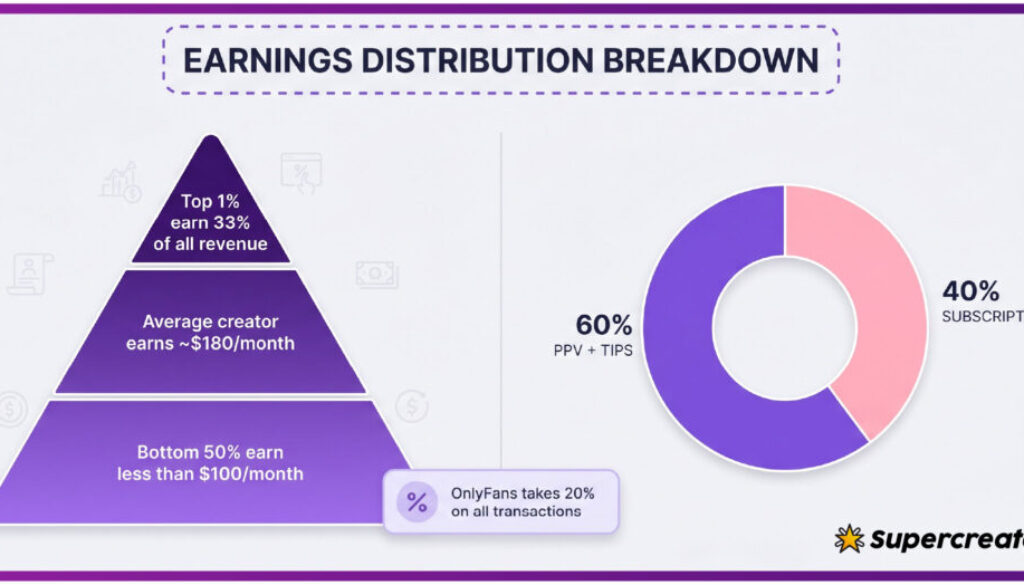
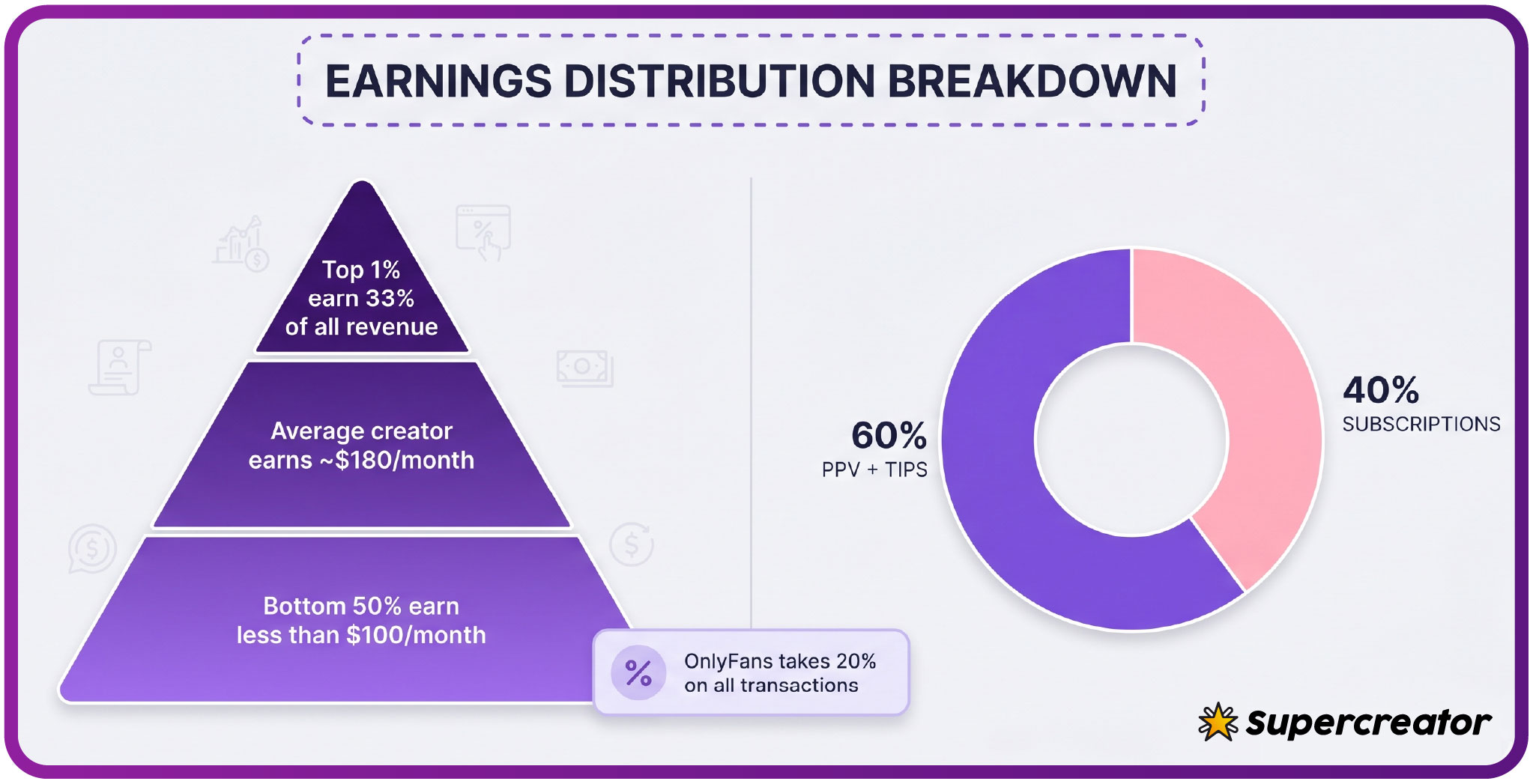
OnlyFans takes 20% of every transaction that moves through the platform, and the creator keeps the remaining 80%. That includes the obvious categories, like monthly subscriptions, and the less visible ones, like a one-off tip sent during a chat.
- Monthly subscription payments
- Pay-per-view (PPV) message unlocks
- Direct tips sent through the chat window
- Custom content payments negotiated in DMs
- Bundled content purchases combining several items
Because the fee sits between the subscriber and the creator’s balance, it functions as an invisible markup. You are not charged extra; the creator simply receives less than the sticker price implies. A $10 subscription on one page and a $10 subscription on another represent the same outlay for you and the same $8 net for both creators.
Watch the checkout screen carefully: the platform never lists the commission as a separate line, so the only place the deduction becomes visible is in the creator’s payout, not in your receipt.
How Creator Pricing Adjusts to Absorb Platform Costs
If the goal is $8 per subscriber per month, the displayed price has to be $10, because 20% of $10 is $2. The subscriber-facing price is the net target divided by 0.8, and every strategy below is a variation on that same arithmetic.
- Direct pass-through markup: raise the displayed price so the net matches the intended figure.
- Volume targeting at lower prices: accept a smaller net per subscriber in exchange for more subscribers.
- Premium positioning for net-margin goals: charge near the top of the range to hit a specific net without high volume.
- Hybrid free and PPV models: set the base price to $0 and recover the fee through unlocks and tips instead.
The fourth strategy is common on free pages, where the subscription costs nothing and revenue arrives through PPV messages and tips. Each of those transactions still carries the 20% deduction, so the free model does not avoid the fee, it relocates it.
Typical paid prices cluster between $4.99 and $15. A creator aiming for a $7 net cannot list $7; the arithmetic forces an $8.75 display price, which is why so many pages settle near $9.99 instead of a round single digit.
Subscriber Perception Gaps: What You Pay Versus What They Keep
When they learn about the 20% cut, the reaction is often that the creator is underpaid or that the subscriber is overcharged, but neither framing is accurate. The fee is a platform cost of doing business, comparable to a marketplace commission.
- Assuming a $10 subscription pays the creator $10, when it pays $8
- Believing a cheap page is always better value, when its net may be too low to sustain output
- Treating a higher price as greed, when it may reflect a higher net target
- Expecting the same output from a $5 page and a $15 page without comparing net revenue
The platform presents a single price, and the split happens behind it. Before that, a short verification hold of $0.10 appears on your card, refunded within days, which some subscribers mistake for an additional fee.
Tip: when comparing two pages, subtract 20% from each displayed price before judging value. A $5 page nets the creator $4, while a $9 page nets $7.20. If the content difference does not justify that gap, the cheaper page is the better comparison, not automatically the worse one.
Ranking Data and Fee-Adjusted Value Metrics
There is no native way to browse creators by category, price, or activity level, and that absence is what makes third-party ranking pages useful. A ranking that sorts purely by displayed price will mislead, and one that ignores price entirely will do the same.
BestOnlyFans methodology treats fee-adjusted value as a scoring input, which means it looks at what a page offers relative to what the creator actually nets after the deduction. Two pages at $9.99 are equivalent in subscriber cost, but if one produces far more content per month, its fee-adjusted value score is higher.
Fee-adjusted scoring also helps flag pages priced near the floor but updated infrequently, since a $4.99 subscription nets the creator $3.99. For subscribers comparing across regions and niches, curation like best onlyfans canada models offers a starting point that already accounts for this kind of variation rather than presenting an unfiltered price list.
Cross-Platform Fee Comparison: OnlyFans versus Competitors
OnlyFans is not the only platform charging a commission, and its 20% rate is neither the highest nor the lowest in the creator-subscription market. The comparison matters because an identical creator income target produces different subscriber prices depending on the platform’s cut.
If a creator wants $8 net per month, the required subscriber price is $10 at a 20% fee, $10.67 at 25%, $11.43 at 30%, and $8.89 at a 10% fee.
- Platforms with roughly 20% commissions produce subscriber prices close to OnlyFans equivalents.
- Platforms with 25-30% cuts require higher displayed prices for the same creator net.
- Platforms with 10-15% cuts can offer lower displayed prices at equal net targets.
- Platforms with flat monthly creator fees shift cost away from per-transaction percentages.
- Platforms with payment-processor surcharges add another layer that compounds the visible price.
This is why a page that looks expensive on one platform may be priced identically in net terms to a cheaper-looking page elsewhere. A subscriber comparing a $10 subscription on a 20% platform against a $10 subscription on a 30% platform is looking at two different net outcomes for the creator.
Price Minimums and Maximums: How Fees Shape the Floor and Ceiling
OnlyFans paid subscriptions run from a $4.99 minimum to a $49.99 maximum, and those boundaries are not arbitrary. They define the range within which a creator can set a base price while the 20% fee applies to every charge. At the floor, a $4.99 subscription nets $3.99.
| Subscriber Price | Creator Net Earnings | Fee Amount | Net as Percentage of Floor |
|---|---|---|---|
| $4.99 | $3.99 | $1.00 | 100% |
| $9.99 | $7.99 | $2.00 | 200% |
| $14.99 | $11.99 | $3.00 | 300% |
| $29.99 | $23.99 | $6.00 | 601% |
| $49.99 | $39.99 | $10.00 | 1002% |
Promotional first months can fall below $4.99, such as a $3 introductory month, but base prices may not. The floor protects a minimum viable net, and the ceiling caps how much a single subscription can cost.
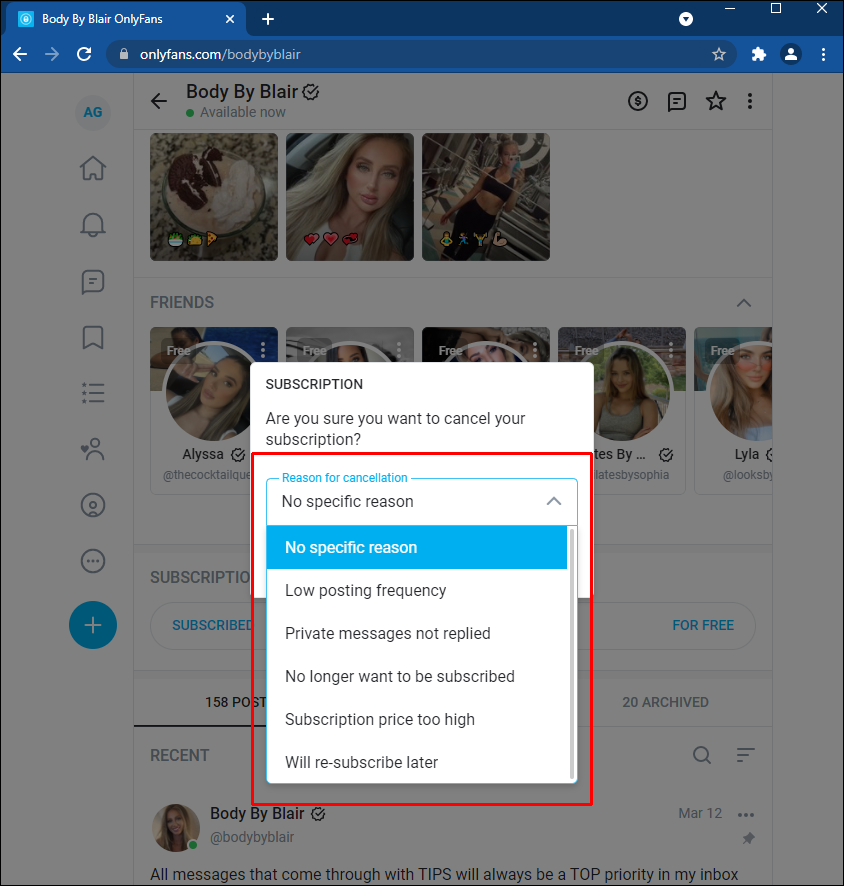
When a creator raises the price, auto-renew stops and existing access lasts until the paid period ends. That mechanic gives subscribers a natural review point each time a page re-prices upward.
The Hidden Math Behind PPV Message Pricing
PPV unlocks can reach $50, and paid chat commonly runs $3 to $5 per message. Both carry the same 20% deduction, which means a free page’s revenue model is built entirely on fee-bearing transactions rather than subscriptions.
For a creator running a free page, the $0 subscription is not income. The fee applies to each unlock, so the effective net per interaction is always 80% of the displayed amount.
| PPV Unlock Price | Creator Receives | Fee Deducted | Messages Needed for Equivalent Subscription |
|---|---|---|---|
| $5 | $4.00 | $1.00 | 2 unlocks to match a $9.99 subscription net |
| $15 | $12.00 | $3.00 | 1 unlock exceeds a $9.99 subscription net |
| $30 | $24.00 | $6.00 | 1 unlock matches roughly three $9.99 subscriptions |
| $50 | $40.00 | $10.00 | 1 unlock matches roughly five $9.99 subscriptions |
This is why free pages can generate more revenue per subscriber than paid pages. A single $30 unlock nets the creator $24, three times the net from a $9.99 monthly subscription. Tips can reach $100, and the same 20% applies, so a $100 tip nets the creator $80.
Paid chat at $3 to $5 per message adds another layer, since each message is a separate fee-bearing transaction. A ten-message exchange at $4 per message costs the subscriber $40 and nets the creator $32, which is more than a full month on many paid pages.
Building Fee-Aware Subscription Budgets
A fee-aware budget does not require you to obsess over creator economics. It requires a simple mental adjustment each time you compare pages, so displayed prices are translated into comparable net figures before you decide.
- Note the displayed subscription price for each page you are considering.
- Multiply by 0.8 to estimate the creator’s net per subscriber.
- Compare that net against the page’s posting frequency and content volume.
- Check whether the page relies mainly on subscriptions or on PPV unlocks.
- Account for promotional first-month pricing separately from the base rate.
- Reassess at renewal, since a price change stops auto-renew and resets the comparison.
Applying these steps turns a list of prices into a list of value propositions. A $15 page that posts daily may net the creator $12 and deliver more than a $5 page that nets $4 and posts rarely.

FAQ
Why don’t subscribers see the platform fee listed separately at checkout?
The 20% deduction happens on the creator side, after the subscriber’s payment is processed, so there is no separate line item for the fee.
Does the 20% fee apply to my OnlyFans wallet balance reload?
Reloading your wallet is not a transaction with a creator, so the commission does not apply to the reload itself. The fee is charged when you spend that balance on a subscription, PPV unlock, tip, or custom content payment.
How does fee-adjusted scoring change the way rankings are built?
It treats the fee as a fixed factor that affects every page equally, then scores pages on what their net revenue appears to support. Posting frequency, content volume, and price-to-output ratios are weighed together instead of ranking pages by displayed price alone.
If a creator wants to earn $10 monthly per subscriber, what must they charge?
The displayed price must be $12.50, because 20% of $12.50 is $2.50 and the creator keeps $10. That price sits within the $4.99 to $49.99 range and above the typical $5 to $10 cluster.