
Aviator Auto-Bet Risks Explained
Aviator is a crash game by Spribe built around an increasing multiplier that can stop at any time. The game lets players automate 10-100 rounds, set an automatic cash-out, and stop after a win or loss.
These controls can make betting easier to repeat, but they do not change the round result or the mathematical edge. This guide explains the automation settings, the main risks, and why a preset system cannot turn a negative expected-value game into a profitable one.
Aviator Round Mechanics
Aviator is a crash game in which the multiplier rises from 1.00x until the round crashes. Each round lasts about 8-30 seconds, with 60-90 rounds possible in an hour.
The crash point is fixed before take-off, and the player must cash out before that point. A cash-out request must reach the server before the crash, so a slow device or connection can cause a cash-out time-out.
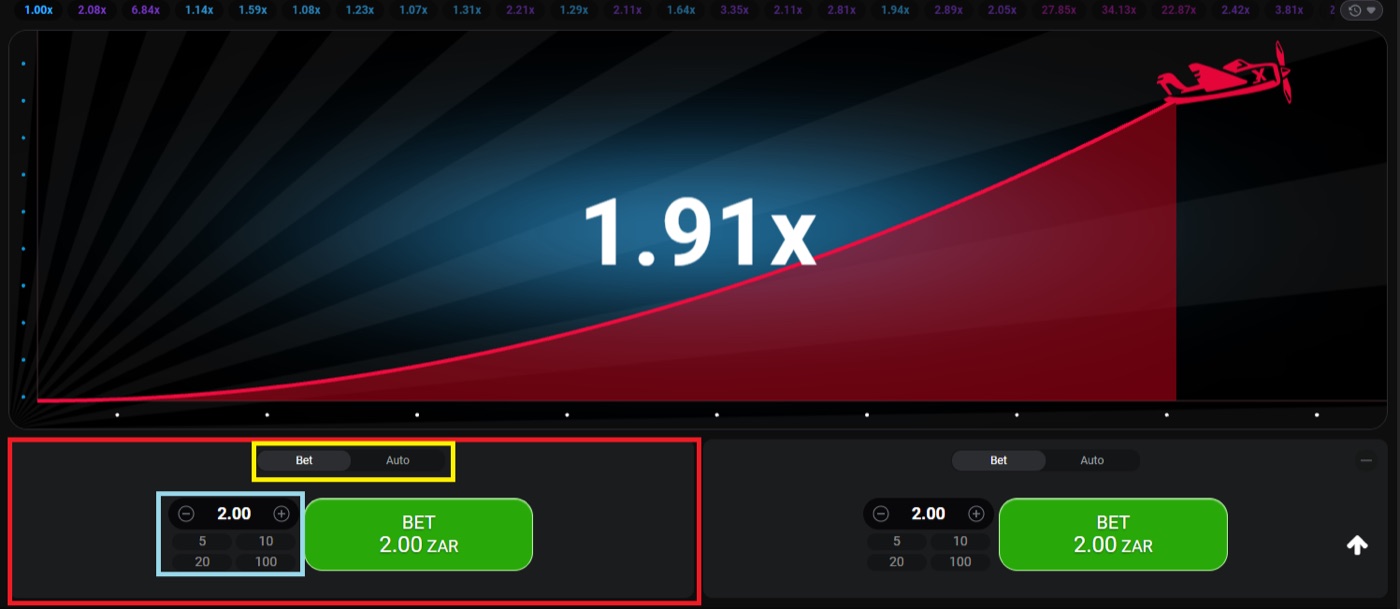
The Aviator desktop round shows the multiplier at 1.91x and two separate bet panels.
Aviator has two bet panels per round. The panels can use separate stakes and separate cash-out targets, which allows a player to manage two bets at the same time.
- The Bet tab places a stake for the current round.
- The Auto tab applies preset instructions to later rounds.
- Auto Cash-Out withdraws a bet at a chosen multiplier if the round reaches it.
- Round history displays previous multipliers at the top of the interface.
- The live bets panel shows All Bets, My Bets, and Top results.
The game also displays a Provably Fair badge and provides an in-game verification tool. Before each round, the server publishes a SHA-256 hash of the server seed, and player client seeds are combined with it.
The inputs are revealed after the round, allowing the result to be checked. Neither Spribe nor the operator can change the result after the round starts, but this fairness process does not make a losing sequence less likely.
Auto-Bet Settings
Aviator Auto Bet or Auto Play can run for 10-100 rounds. The setting repeats the chosen stake and cash-out instructions without requiring a new manual click for every round.
Stop-on-win and stop-on-loss end the sequence when the selected condition occurs. These controls stop future bets, but they do not alter the crash point, the RTP, or the outcome of a round already in progress.
- Select Auto rather than Bet.
- Choose an automatic stake for each round.
- Set an Auto Cash-Out multiplier.
- Choose a round count from 10 to 100.
- Add a stop-on-win or stop-on-loss condition if required.
- Review the settings before starting the sequence.
A 10-round sequence and a 100-round sequence have different exposure. A longer sequence creates more chances to place a stake, so the total amount risked can rise even when the stake on each round stays the same.
For example, a $1 stake across 10 rounds exposes $10 before any returns are considered. The same $1 stake across 100 rounds exposes $100. The final result still depends on the independent crash points and the cash-out target.
Auto Cash-Out can reduce the need to react during a rising multiplier. It cannot guarantee that the multiplier reaches the selected level, and it cannot cash out after the crash has already happened.
- A target of 1.5x returns the stake plus the 0.5x profit when reached.
- A target of 2x doubles the stake before any operator rules about rounding or caps.
- A target of 10x needs a much less frequent result than a target of 1.5x.
Stop-On-Loss Limits
Stop-on-loss ends an Auto Bet sequence after the selected loss condition. A stop-on-loss rule therefore limits the number of later bets, but it does not recover the stake lost on the triggering round.
Stop-on-win ends the sequence after the selected win condition. A stop-on-win rule preserves a chosen result only by preventing later automated bets; it does not make the next round safer.
The wording of an operator’s setting can determine how the condition works, so the exact behaviour depends on the operator. A player should check whether the setting means one losing round, a monetary loss, or another displayed condition before activating it.
Consider a sequence with a $1 stake, a 1.5x Auto Cash-Out, and stop-on-loss after one loss. If the first round crashes at 1.20x, the sequence stops with a $1 loss. The setting prevents the next automatic bet, but it does not change the 1.20x result.
Now consider a sequence that wins at 1.5x and uses stop-on-win. The return is $1.50, including the original $1 stake, and the profit is $0.50. If the sequence stops at that point, the player avoids later exposure, but the single winning round does not remove the game’s house edge across repeated play.
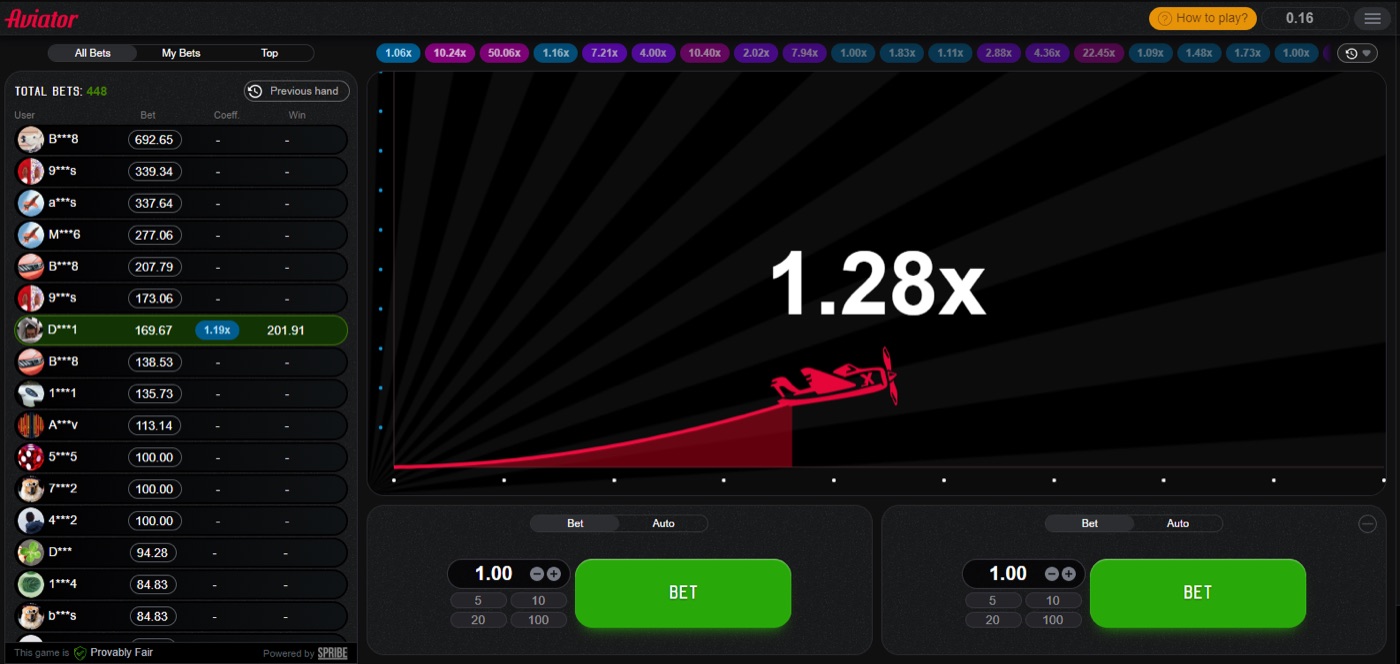
The Aviator game screen shows the plane in flight while the multiplier rises before the crash.
- Use a round limit to cap the number of automatic attempts.
- Use stop-on-loss to prevent an unwanted continuation after a loss.
- Use stop-on-win to end a sequence after a defined result.
- Do not treat a stop rule as a prediction tool.
Automation can also make losses less visible during rapid play. Several rounds can pass in a short period, and the player may focus on the preset instruction instead of the running total.
Responsible gambling means setting a loss limit before play and stopping when that limit is reached. Auto-bet should never be used to chase a previous loss.
Probability And RTP
Aviator has an RTP of 97% and a house edge of 3%. The expected value is minus 3% of the stake at every cash-out target.
The probability that a round reaches multiplier m is 0.97 divided by m. This probability describes the game’s published mathematics, not a promise that a fixed number of rounds will contain a particular result.
| Cash-out target | Probability of reaching it |
|---|---|
| 1.2x | 80.8% |
| 1.5x | 64.7% |
| 2x | 48.5% |
| 3x | 32.3% |
| 5x | 19.4% |
| 10x | 9.7% |
| 20x | 4.85% |
| 50x | 1.94% |
| 100x | 0.97% |
About 3% of rounds crash instantly at 1.00x, which is roughly 1 in 33 rounds. That figure does not mean every group of 33 rounds contains exactly one instant crash.
Suppose a player stakes $1 and sets Auto Cash-Out at 2x. The round reaches 2x with a probability of 48.5%. A successful cash-out returns $2, while a crash below 2x loses the $1 stake.
The expected value remains negative because the 97% RTP applies to the stake over repeated play. Auto-bet repeats the same mathematical position; it does not remove the 3% edge.
For a $100 total amount wagered, the stated RTP corresponds to an expected return of $97 and an expected loss of $3 over a large number of comparable bets. Actual results can differ because Aviator is a high-variance game.
Players who use a crash game, multiplier, cash-out, or stake system on a bookmaker site, including aviator 1xbet, still face the same core probability issue: the automated instruction does not change the game’s expected value.
Why Automation Cannot Win
Independent Aviator rounds do not remember earlier results. A crash at 1.00x does not make a high multiplier due, and a 20x result does not make the next round more likely to crash early.
Automation changes the timing and number of bets, while the 3% house edge remains in each bet. The result is a change in variance and exposure, not a change in the underlying advantage.
A 100-round Auto Bet can feel more systematic than manual betting because it applies identical instructions. It remains a series of separate wagers with separate possible losses.
- Patterns in round history do not change the next round’s probability.
- Graph analysis does not reveal a future crash point.
- A best time to play does not improve the published odds.
- A strategy chart PDF does not alter the 97% RTP.
- Playing off-peak may support a smoother connection, but it does not improve odds.
Martingale is a clear example of automation risk. The system doubles the stake after each loss, and after 10 losses the stake reaches 1,024 times the base stake.
A $1 base stake would therefore require a $1,024 stake after 10 consecutive losses. The progression does not remove the loss probability, and it can increase the amount exposed when a losing sequence continues.
Fibonacci and D’Alembert systems also change stake size rather than the crash distribution. None of these systems beats the 3% edge.
A split-bet approach can divide exposure between two panels. One bet might use a 1.5x-2x cash-out while another aims at 5x-10x, but the two bets still face the same round’s crash point and the same house edge.
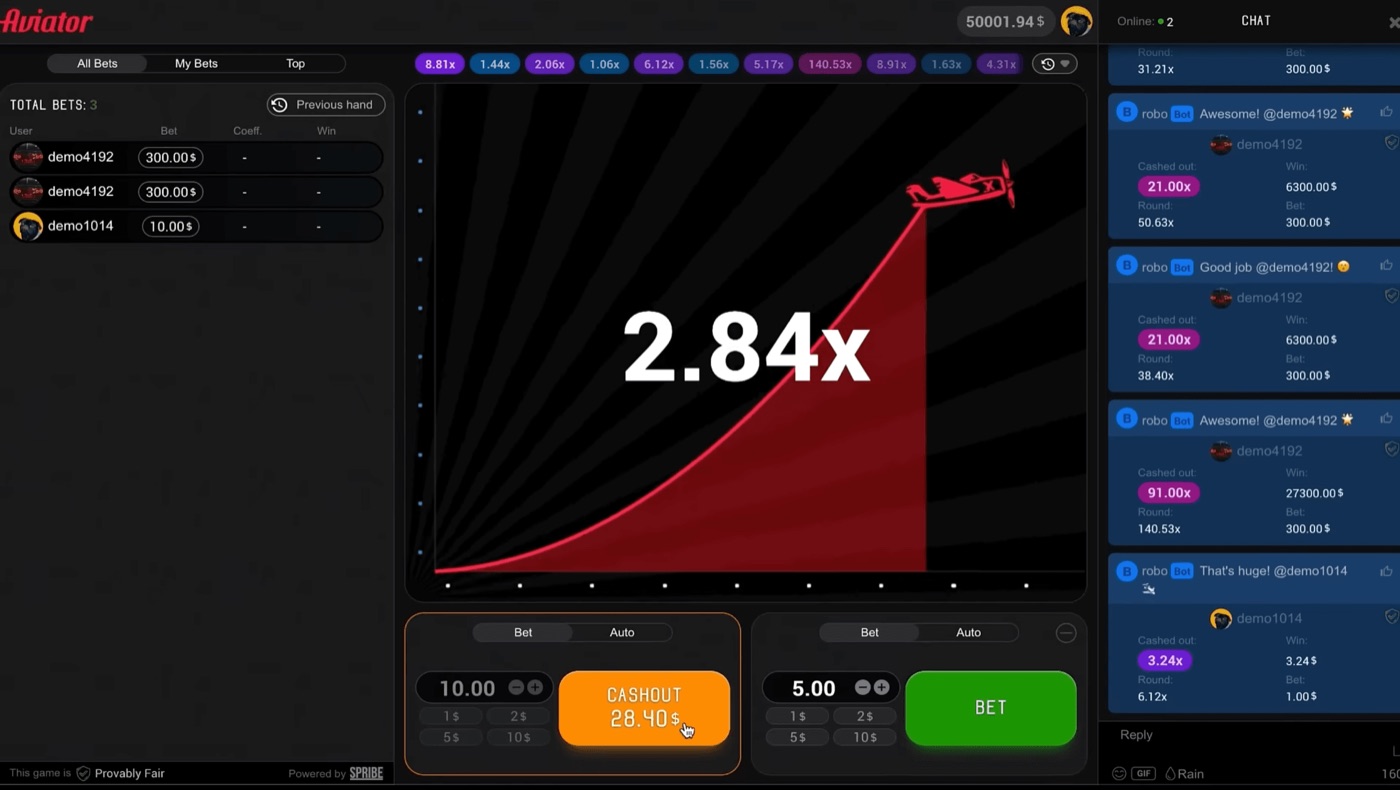
The Aviator interface combines live bets, chat, and a displayed cash-out at 28.40.
Automation Risk Controls
Aviator supports Auto Bet for 10-100 rounds and separate cash-outs on two bet panels. These features give players more control over repetition, but they also make it easier to continue staking without a fresh decision each round.
The operator sets the available stake range and win caps, so those values depend on the operator. Typical stakes can range from about $0.10 to $100 per bet, but the displayed amount is not universal.
Before starting an automated sequence, a player can write down the total planned exposure. This calculation should include the number of rounds, the stake per round, and any second bet placed in the same round.
- Set the total amount before opening Auto Bet.
- Choose a round count that fits that amount.
- Keep the stake unchanged instead of increasing it after a loss.
- Use stop-on-loss as a limit, not as a recovery method.
- Check the running balance after the sequence ends.
Demo mode is available through an operator demo or demo.spribe.io and needs no registration. Demo play can show how the 10-100 round controls, cash-outs, history, and stop conditions work without using a real stake.
Connection quality matters to the timing of a cash-out request. The game works on desktop, tablet, and mobile browsers and was built for low bandwidth and budget devices, but a time-out can still occur if the request reaches the server after the crash.
A player should not use a third-party predictor or signal bot as an automation aid. The crash point is committed by hash before the round, so prediction cannot be obtained from an app, a public-math bot, or a version label such as “Predictor v4.0”.
Aviator FAQ
Spribe launched Aviator in early 2019, and the game uses automatic cash-out and Auto Bet controls. The following answers address the main risks of using those controls.
Aviator is not a slot and has no bonus round. Its result is a crash point fixed before take-off, with a 97% RTP and a 3% house edge.
Can Auto Bet beat Aviator?
No. Auto Bet repeats the chosen stake and instructions, but the expected value remains minus 3% of the stake at every cash-out target. Automation changes the number and timing of bets, not the game’s edge.
What does stop-on-loss do?
Stop-on-loss ends the automated sequence after the selected loss condition. It prevents later bets after that condition, but it does not recover the triggering loss or change the crash result.
Can 100 rounds improve the odds?
No. A 100-round sequence creates more exposure than a 10-round sequence when the stake is the same. The rounds remain independent, and the published probabilities do not improve because Auto Bet runs for longer.
Can an Aviator predictor know the crash point?
No. The crash point is fixed before take-off through the provably fair process, and the server seed is revealed after the round. Predictor apps and signal bots cannot change or reliably forecast that committed result.
Why did my cash-out time out?
The cash-out request must reach the server before the crash. Latency or a slow device can delay the request, so a time-out can occur even when the multiplier was visible on the screen.
Is a low cash-out target risk-free?
No. A lower target has a higher probability of being reached, but it can still lose when the round crashes before that target. At 1.5x, the stated probability is 64.7%, so the target is not guaranteed.